

THABO MBEKI
THESEUS:
Because (to chorus) —
(to camera) We have to work to increase the levels of investment.
We will continue to intensify our work to facilitate investment.
The trickle-down must trickle.
Leading players in the global economy
continue to bring their blessings to us,
driven by passion and desire to ensure that we succeed.
Our economy has gathered considerable momentum in the third quarter,
raising this country’s international reserves holdings to their highest level ever.
We are breaking our constraints, and catapulting the economy to higher levels of growth.
We are marching into a new era, of victory, and not victimhood!
We are striking bonds of solidarity and friendship!
We must work together with renewed vigour, to fulfil our dreams.
(raises fist) This is our century!
Wedged in between extracts developed from Sophocles’ Oedipus at Colonus, where Oedipus implores Theseus to grant him a resting place and Theseus deliberates what is in it for him, suddenly, he turns to a camera, speaking into a microphone, and delivers this speech. The audience is transported back to the early 2000s, watching Thabo Mbeki on screen, drawing upon the rhetoric of international politics in a bid to ameliorate himself and his country to the West. The speech is met with stunned perplexity from the chorus.
On the tenth day of rehearsals, Faniswa, Andrew, the chorus, and Mark begin workshopping how Theseus will endeavour to convince the people to receive Oedipus in their land. After several rounds of improvising, Mark gives Faniswa a speech of Mbeki’s from Africa: Define Yourself, which provides the kernels for the speech used in the final staged version. Watch the first workshopping of Theseus’ Mbeki-an ‘gobbledygook’, which the chorus respond to with, alternately, stunned silence, and laughter:
Robyn Cohen observed, in a review for The Cape Robyn, that the characterisation of Theseus is loaded with the ‘stuff’ of contemporary politics. Yet, the rehearsal footage shows us just how deep this ‘stuff’ runs, to the point where study of Thabo Mbeki provided the fundamental basis for constructing Theseus’ character.


The cast experiment with different ways of spatially expressing Theseus’ sense of superiority,
having Faniswa first carried in on a table, and then, arranging a series of tables as an elevated pathway.
How political was Theseus in Sophocles’ play? There is no scholarly consensus, but a politicised reading views Theseus’ Athens as a veiled reference to Pericles’ Athens, which the ancient historian Thucydides described as ‘a democracy in name, but in actuality, the rule of one man’ (2.65.9). This potential to use Theseus as an allegory for a recent ruler of a new democracy proves immensely fruitful for Oedipus at Colonus #aftersophocles.
Mbeki as a model for Theseus is presented as an idea from the very first planning sessions. In Mark and Faniswa’s first workshop analysing the character, Mark describes the similarities he perceives between Theseus and Mbeki: both are anointed successor from an early age, chosen to lead their land as a free democracy. Prior to accession, however, both went into exile. Through time spent in the Soviet Union and study in the United Kingdom, Mbeki acquired a taste for English literature and a degree in economics, comfortably assimilating into Western ‘intellectual’ culture. As Daniel Roux describes (2015: 7):
Taciturn, but given to oratorical flourish, he presented himself as an intellectual and patrician statesman, with grand ambitions not only for South Africa but for the African continent as a whole. Under his technocratic leadership, the government entrenched a centrist, essentially neo-liberal approach to governance and the economy that alienated the ANC’s leftist partners.
As a result, there emerged a tension between president and people.
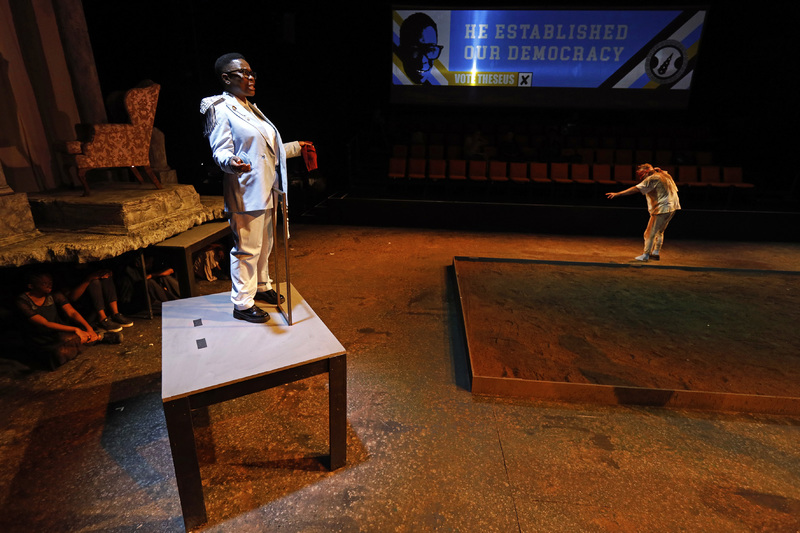
Theseus stands upon a podium to engage in a political debate with Creon.
In the background is projected a banner, ‘Vote Theseus’, with the tagline: ‘He established our democracy.'
To immerse herself in Mbeki-as-Theseus, Mark asks Faniswa to cull extracts from a collection of presidential speeches, using Mark Gevisser’s Thabo Mbeki: The Dream Deferred and Mbeki’s Africa: Define Yourself to create two monologues, a speech that he would deliver in public, and a stream of consciousness that reflects the ruler’s more private thoughts, which he would only express behind closed doors. The following day, Faniswa presents these speeches. Watch her read through the two monologues and discuss them with Mark.
The first speech, comprised of quotes drawn together from various speeches Mbeki delivered, is a tour de force of grandiose rhetoric, lofty ideals, and little real substance:
Now, I am not talking about welfare handouts, but about investment.
Knowledge transfers.
The people have spoken.
The burden of our prayer to you today has been that
all of us must hold firm to the correct cause we have chosen,
and hold firm to our resolve to walk that road together.
When I made this point, I believed it to be true,
and remain convinced that I was right.
I think there cannot be anything more heroic than to be described as
one in whose hands the revolution would be safe.
Over the following weeks, Faniswa uses improvisation to develop this pompous character, who endeavours to present himself as a man most at home in a Westernised world. Working in tandem with Jennie to workshop a movement vocabulary for the two kings under Ina’s direction, Faniswa performs a routine where Theseus is alone in his bedroom, dressing himself for a day’s work.
Over the course of 5 minutes, she caresses then dons a suit jacket, standing tall and proud, smoking from a pipe. As soft classical music plays, she begins ballroom dancing, as if with a partner, imagining participating in an elegant ball with the upper echelons of society. After a few moments, she pauses, looking down at two other clothing options lying upon the table: a high-vis worker’s jacket, and an African print T-shirt. Contemplating exchanging her business suit for the clothing of ‘the people’, over the next few minutes, she plays out Theseus-as-Mbeki’s internal struggle, expressing an intense discomfort with, even hatred for, ‘commonness’. Watch this improvisation:
This dressing scene, which was workshopped for several weeks, ultimately did not feature in the play, but provides an important insight into Theseus’ character-building, giving context for how he presents himself before the chorus. It is through drawing upon political satire, even when subtly expressed, that Theseus is brought into the modern world and is able to cast a tragic shadow on the events of Oedipus at Colonus #aftersophocles, rendering the tragedy at once ancient and border-defiant, and at the same time post-apartheid and local, rooted in the recent past.

Theseus in his business suit, exuding an air of confidence.
